Loading the network…
Metaphysics & Pantheism
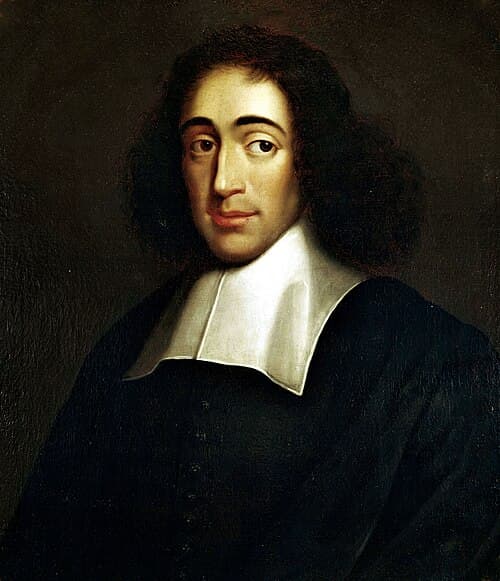
Baruch Spinoza
1632 – 1677
“I have striven not to laugh at human actions, not to weep at them, nor to hate them, but to understand them.”
The excommunicated lens-grinder who identified God with Nature. Spinoza's rigorous geometrical method produced a monist philosophy of radical freedom.
Biography
Baruch Spinoza (1632–1677) was born into a Portuguese-Jewish family in Amsterdam. His pantheistic ideas led to his excommunication from the Jewish community at age twenty-three.
The Ethics is written in the form of Euclid's Elements — definitions, axioms, propositions, demonstrations — a deliberate claim that metaphysics can achieve the certainty of mathematics. Its central thesis is that there is only one substance, which Spinoza calls God or Nature.
From this monism flows a philosophy of freedom: human beings are free insofar as they act from their own nature rather than from external compulsion.
Important Works
Ethics
1677A geometric proof of monism: God, Nature, mind, and freedom shown to follow necessarily from definitions.
Tractatus Theologico-Politicus
1670A pioneering work of biblical criticism and an early defence of freedom of thought.
Key Takeaways
- God and Nature are one infinite substance (pantheism / monism).
- Emotions are understood, not suppressed: adequate ideas dissolve passive affects.
- Freedom is acting from one's own nature, not the absence of determination.
- The highest human good is the intellectual love of God.
- Geometric method applied to ethics: philosophy can be as rigorous as mathematics.